
Research Article
Received: 2022-05-30 | Revised:2022-06-17 | Accepted: 2022-06-22 | Published: 2022-07-22
Pages: 47-55
DOI: https://doi.org/10.56717/jpp.2022.v01i01.006
Abstract
Holigarna
caustica,
commonly known in Bangladesh as "Katebel," is used in traditional
medicine to treat tumors, malignancies, skin problems, obesity, inflammation,
eye irritation, and arthritis. The goal of this work was to use computational
models like molecular docking to find the bioactive phytochemicals in this
plant that are responsible for the anticancer potential. The molecular docking
experiment was carried out using Glide of Schrödinger Maestro (version 10.1).
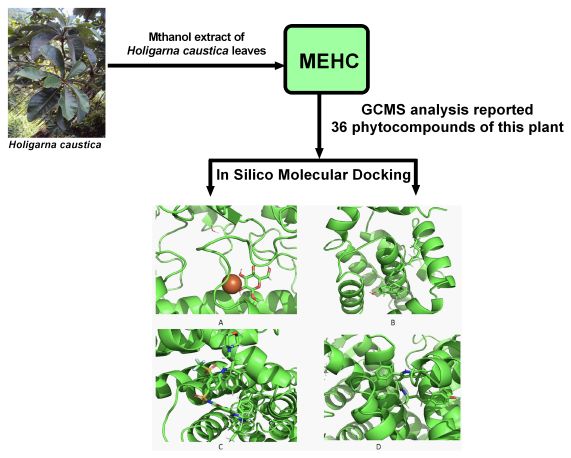
Our computational research revealed that a total of eighteen phytocompounds may
be responsible for the plant's anticancer properties, which should be further
studied in experimental models.
Abstract Keywords
Holigarna
caustica, bioactive compounds, cancer (lung
and breast), molecular docking study

This work is licensed under the
Creative Commons Attribution
4.0
License (CC BY-NC 4.0).
Abstract
Holigarna
caustica,
commonly known in Bangladesh as "Katebel," is used in traditional
medicine to treat tumors, malignancies, skin problems, obesity, inflammation,
eye irritation, and arthritis. The goal of this work was to use computational
models like molecular docking to find the bioactive phytochemicals in this
plant that are responsible for the anticancer potential. The molecular docking
experiment was carried out using Glide of Schrödinger Maestro (version 10.1).
Our computational research revealed that a total of eighteen phytocompounds may
be responsible for the plant's anticancer properties, which should be further
studied in experimental models.
Abstract Keywords
Holigarna
caustica, bioactive compounds, cancer (lung
and breast), molecular docking study
This work is licensed under the
Creative Commons Attribution
4.0
License (CC BY-NC 4.0).
Editor-in-Chief


This work is licensed under the
Creative Commons Attribution 4.0
License.(CC BY-NC 4.0).